
Dubai Metro Gold Line: everything confirmed so far
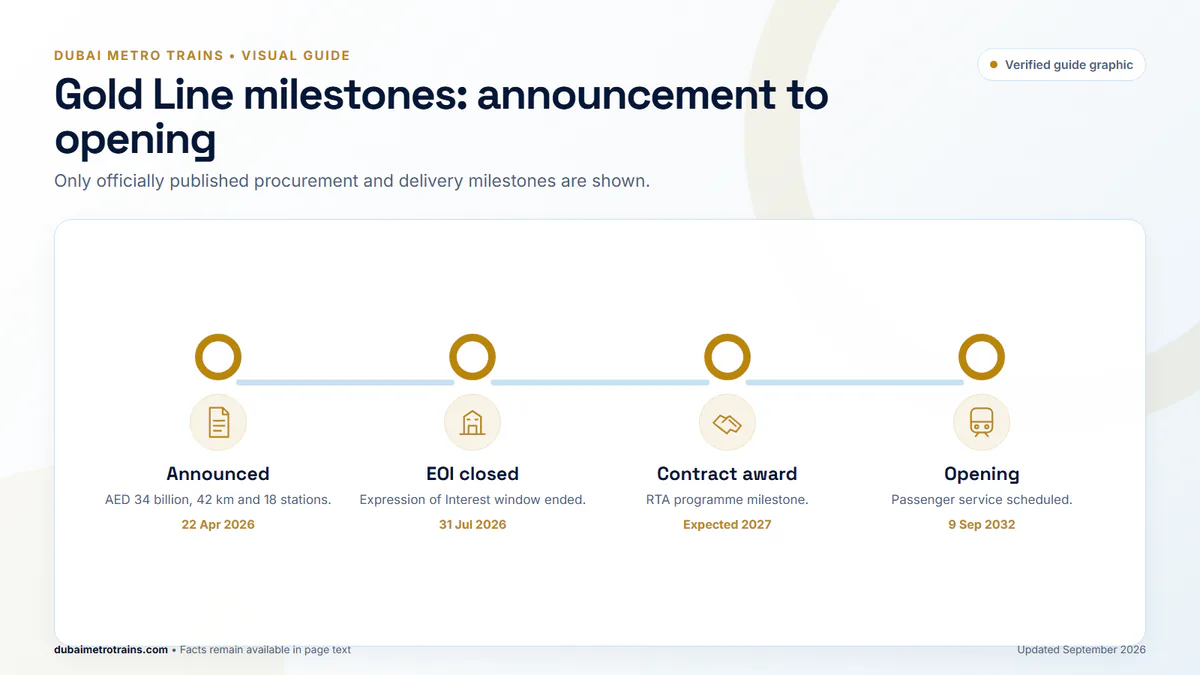
Announced on 22 April 2026 by HH Sheikh Mohammed bin Rashid Al Maktoum, the Gold Line is Dubai’s next metro megaproject - and this page tracks it fact-by-fact as the RTA publishes details. No speculation presented as fact, ever: where reporting is unconfirmed, we say so.
Investment
AED 34 billion
Route length
42 km
Stations
18
Depth
~40 m
Fully underground
100%
Opens
Sep 9, 2032
Live tender tracker
Next milestone: Main construction tender scheduled for issuance — 2026. This table is updated within a day of each RTA announcement.
| Date | Milestone | Status |
|---|---|---|
| 2026-04-22 | Line announced by HH Sheikh Mohammed | Done |
| 2026-07-31 | Expression of Interest submission deadline | Done |
| 2026 | Main construction tender scheduled for issuance | Upcoming |
| 2027 | Contract award (expected) | Upcoming |
| 2032-09-09 | Opening | Upcoming |
Where things stand right now: the Expression of Interest window closed on 31 July 2026. RTA’s confirmed programme schedules the main construction tender for issuance in 2026, the contract award in 2027, and the opening on 9 September 2032. We will add the shortlist only after the RTA publishes it.
Reported, not yet confirmed by the RTA (25 September 2026): the trade publications MEED and Arabian Business report that the deadline for contractors’ prequalification statements has been extended to 9 October 2026, after earlier reported dates of 17 August and 7 September. This is a separate contractor step from the Expression of Interest above. The RTA has not published the date on its public Gold Line pages, so it stays out of the milestone table until it does — our tender coverage explains the difference.
The route: Al Ghubaiba to Jumeirah Golf Estates
Al Ghubaiba to Jumeirah Golf Estates, serving 15 strategic areas. The line runs entirely underground at around 40 metres - Dubai’s first fully underground metro line - which is why it can cut directly beneath the built-up coastal corridor no elevated line could cross. Along the way it will serve roughly ~1.5 million residents and 55 major real-estate developments.
Confirmed interchanges
- Al Ghubaiba — green
- Business Bay — red
- Jumeirah Golf Estates — red + Etihad Rail
- Meydan — Etihad Rail
- BurJuman — red/green (unconfirmed - see note below)
One ambiguity worth flagging honestly: some coverage of the 2032 network map also shows a BurJuman connection. The RTA has not confirmed it, so we list it as exactly that - shown on some maps, not announced. When the RTA settles it either way, this section changes the same day.
25% or 35%? The expansion number, fact-checked
- Myth: The Gold Line expands the metro network by 25%
- Fact: Early reports said 25% network expansion - the official Dubai Media Office figure is 35%
Early reports ran with 25%, and that number still circulates. The official Dubai Media Office figure is 35%: 120 km to 162 km; 67 to 85 stations, with the baseline including the future Blue Line. The 67-station baseline includes the future Blue Line, not just today’s network. See the map page.
What the Gold Line changes
- Expected to cut Red Line crowding between BurJuman and ONPASSIVE by 23%
- Removes 40+ million road journeys per year
- Ridership target 465,000/day beyond 2040
- 430% projected 20-year economic return
The congestion number is the one existing riders should care about: the RTA projects a 23% reduction in Red Line crowding between BurJuman and Garmin - today’s most crushed stretch - because the Gold Line gives the coastal corridor its own parallel spine. It is also projected to remove more than 40 million road journeys a year, with a ridership target of 465,000 passengers a day beyond 2040 and a projected 430% twenty-year economic return.
Station names: not announced (and what the speculation says)
The RTA has not published Gold Line station names or locations. Any list you see presented as final is ahead of the facts. What exists is informed speculation: Time Out Dubai read likely locations off the 2032 masterplan map - Al Mina Street, two Satwa stops, City Walk, Downtown, two District One stops, the Global Village area, and Meydan among them. Plausible? Yes, they track the confirmed corridor. Confirmed? No. We will publish the official list within a day of the RTA announcement, and not a moment before - that is policy.
Why a fully underground line takes six years
Forty metres down is deeper than most of the existing network’s underground section, below utilities and foundations, which means tunnel boring machines working full corridor lengths, deep station boxes at every stop, and years of systems integration and trial running before passengers board. Dubai’s track record here is strong - the original metro opened on schedule in 2009 and the Blue Line is tracking to 2029 - so the 2032 date deserves the benefit of the doubt. Each construction phase will appear in the tracker above as it is awarded.
The corridor it will serve
The Gold Line’s value is geographic: it runs under the coastal band that the elevated Red Line never reached, from old Dubai out to the golf-estate suburbs, linking fifteen strategic areas the RTA has flagged for growth. Because it is fully underground - a first for the network - it can cut directly beneath Satwa, the City Walk and Al Wasl districts, Downtown’s edge and the Business Bay canal without threading between existing towers. The announced anchors are the confirmed interchanges - Al Ghubaiba at the old-Dubai end (Green Line), Business Bay mid-route (Red Line), and Jumeirah Golf Estates at the far end (Red Line plus Etihad Rail) - with Meydan added as an Etihad Rail connection. The line is projected to serve around 1.5 million residents and connect more than fifty major real-estate developments along the way.
Why it matters to today’s riders
Even if you never ride it, the Gold Line changes the network you already use. Its headline job is congestion relief: the RTA projects it will cut crowding on the Red Line’s worst stretch - between BurJuman and Garmin - by around 23%, because it gives the coastal corridor its own parallel spine instead of funnelling everyone through the central Red Line. Alongside that, it is forecast to remove more than 40 million car journeys a year, carry a target of 465,000 passengers a day beyond 2040, and return an estimated 430% on its cost over twenty years. Together with the Blue Line, it takes the network from 120 km to 162 km and, on the RTA’s counting, from 67 to 85 stations - the 35% expansion the Dubai Media Office cites, not the 25% figure that circulated early.
How to follow the build
This line is our recurring-freshness page: it updates after each official RTA milestone. The EOI window closed on 31 July 2026; tender issuance is scheduled for 2026, contract award for 2027, and opening for 9 September 2032. The one thing we will not do is print a shortlist or station names before the RTA announces them; until then they remain unconfirmed.
Gold Line: your questions answered
When does the Dubai Metro Gold Line open?
September 9, 2032 - continuing Dubai's 09/09 opening tradition (Metro 2009, Blue Line 2029).
What is the Gold Line route?
Al Ghubaiba to Jumeirah Golf Estates: 42 km, 18 stations, entirely underground at around 40 m depth, serving 15 strategic areas and about 1.5 million residents.
How much does the Gold Line cost to build?
AED 34 billion, announced on April 22, 2026 by HH Sheikh Mohammed bin Rashid Al Maktoum.
What are the Gold Line station names?
Not announced. The RTA has published the corridor and interchanges but no station list. Published "lists" are speculation from the 2032 map - we track the official announcement here.
Where does the Gold Line connect to the existing metro?
Confirmed: Al Ghubaiba (Green Line), Business Bay (Red Line) and Jumeirah Golf Estates (Red Line + Etihad Rail), plus Meydan on Etihad Rail. A BurJuman link appears on some maps but is unconfirmed.
Is the Gold Line the same as the Blue Line?
No - the Blue Line (14 stations, opens 2029) serves the east: Festival City, Creek Harbour, International City, Silicon Oasis. The Gold Line (18 stations, 2032) runs under the coastal corridor from old Dubai to JGE.
Will the Gold Line be fully underground?
Yes - Dubai's first fully underground metro line, running at roughly 40 m depth for all 42 km.
When will Gold Line construction start?
RTA schedules tender issuance in 2026 and contract award in 2027, after which construction begins. The line is scheduled to open on 9 September 2032.
Which developer areas does it serve?
The RTA cites 55 major real-estate developments along the corridor - the announced interchanges anchor it at old Dubai, Business Bay and the JGE/Etihad Rail hub.
How big is the expansion in network terms?
The official figure is 35%: the network grows from 120 km to 162 km and from 67 to 85 stations (including the future Blue Line). The 25% figure from early reports is outdated.
Tracker reviewed after official RTA milestones. Related: Blue Line tracker · metro news.